

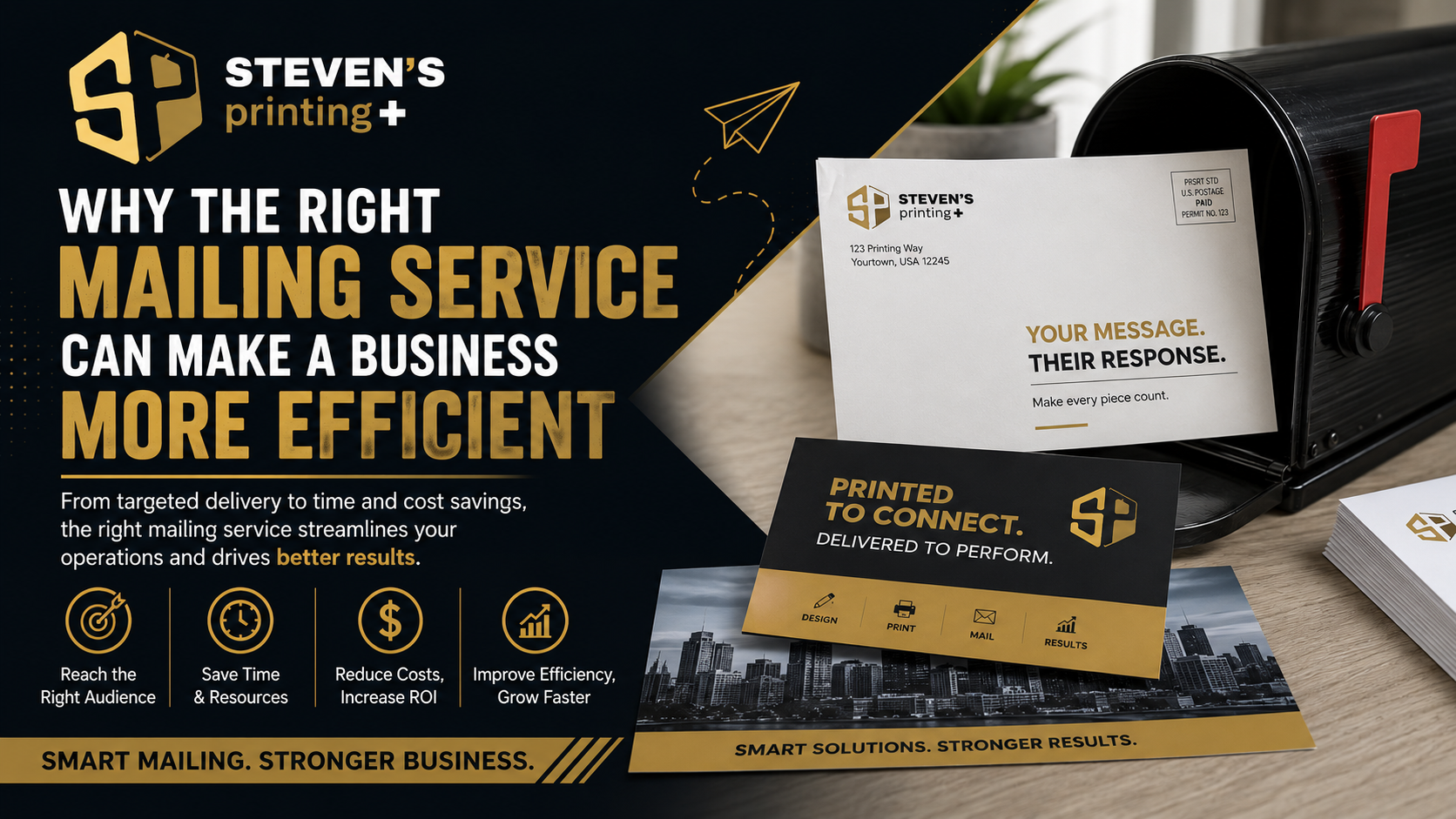
Mailing is easy to underestimate.
For many businesses, it begins with something that seems simple: print a letter, prepare an envelope, add an address, put on postage and send it.
But anyone who manages a large mailing campaign knows that the process is rarely that simple.
Behind every successful mailing campaign are dozens of small decisions—data accuracy, address quality, printing, personalization, folding, inserting, sorting, postage, scheduling, tracking and delivery. When those pieces work together, mailing can become an efficient and surprisingly powerful part of a business’s marketing, communication, and customer-retention strategy.
When they do not, the problems can multiply quickly.
A bad mailing service does not merely produce an unattractive piece of mail. It can waste time, increase costs, delay important communication, damage customer relationships and create unnecessary work for the people who are already running the business.
That is why choosing the right mailing service is less about finding someone who can send mail and more about finding a partner who can make the entire process work.
Good Mailing Starts Before Anything Reaches the Mailbox
The most important part of a mailing campaign may happen long before the first envelope is printed.
It starts with the data.
Businesses often have thousands—or even hundreds of thousands—of customer, donor, member, student, prospect or household records. Those databases can contain outdated addresses, duplicates, incomplete information and other inconsistencies.
If that information is not handled properly, the mailing campaign can begin with a problem before anything is physically produced.
A professional mailing service can help organize, clean and prepare mailing data so that the campaign has a stronger foundation.
That matters because every undeliverable piece represents more than wasted postage.
There is also the cost of printing, preparation, labor and the opportunity cost of sending a message to the wrong address.
Good mailing is therefore partly an exercise in preventing waste.
Efficiency Is One of the Biggest Benefits
Consider what happens when a business tries to manage a large mailing campaign internally.
Someone has to organize the list.
Someone has to prepare the artwork.
Someone has to print the materials.
Someone has to fold or finish them.
Someone has to match documents with envelopes.
Someone has to apply addresses and postage.
Someone has to sort everything correctly.
Someone has to get the mailing to the postal system.
For a small campaign, that may be manageable.
For thousands of pieces, it can quickly become a major operational project.
Outsourcing these processes to an experienced mailing service can free employees to focus on the work they were actually hired to do.
A nonprofit can spend more time engaging donors.
A school or university can focus on students and families.
An insurance company can focus on policyholders and claims.
A real estate company can focus on clients and properties.
A home-service business can focus on customers and technicians.
The value is not simply that someone else handles the mail.
The value is that the business gets its time back.
For Nonprofits, Mailing Can Be Closely Connected to Revenue
Few industries demonstrate the importance of organized mailing better than the nonprofit sector.
Fundraising campaigns often depend on communicating consistently with donors and supporters. A nonprofit may need to send appeals, newsletters, annual reports, event invitations, acknowledgments, and other communications throughout the year.
A poorly managed mailing can create unnecessary expense at exactly the wrong time.
Imagine spending money printing thousands of fundraising letters, only to discover that a significant portion of the database contains outdated addresses.
Or imagine a campaign arriving late because the mailing process was not scheduled properly.
The problem is no longer simply a mailing problem.
It can become a fundraising problem.
A well-managed mailing operation can help nonprofits segment their audiences, personalize communications, maintain cleaner databases, and coordinate campaigns around important fundraising periods.
When resources are limited, eliminating avoidable waste becomes particularly valuable.
Education Institutions Have Their Own Mailing Challenges
Schools, colleges and universities communicate with a remarkably broad audience.
Students, parents, alumni, faculty, prospective students and donors may all require different communications.
Admissions materials might need to reach prospective students. Alumni organizations may send fundraising campaigns. Schools may distribute event information, newsletters, annual communications and important institutional notices.
A mailing service that understands the importance of accurate data and deadlines can make these campaigns considerably easier to manage.
The alternative can be frustrating.
Incorrect addresses can mean important information never reaches families. Poorly organized lists can create duplicate mailings. Last-minute production problems can delay time-sensitive communications.
Education already involves enormous amounts of coordination.
Mailing should not become another source of chaos.
Insurance Companies Cannot Afford Sloppy Communication
Insurance is another industry where communication matters.
Policyholders may receive renewal notices, statements, policy information, promotional materials and other important documents.
Accuracy is critical.
A mailing that contains an incorrect name, outdated address or incorrect document can create confusion and potentially require additional customer-service work.
A professional mailing process can help organize high-volume communications while maintaining consistency and accuracy.
For insurance companies, efficiency is not simply about reducing the cost of postage.
It is also about reducing avoidable questions, returned mail and administrative work.
Real Estate Depends on Consistency
Real estate professionals have long used direct mail to build awareness within specific geographic markets.
Agents may send postcards to neighborhoods, property announcements to targeted audiences, market updates to homeowners or follow-up communications to previous clients.
The challenge is consistency.
A real estate professional might have excellent creative material but still struggle if the mailing list is poorly maintained or campaigns are difficult to execute.
A good mailing service can make recurring campaigns easier to manage.
That consistency matters because real estate marketing is often about staying visible over time.
One postcard rarely builds a reputation.
Repeated, relevant communication can.
Home-Service Businesses Can Turn Mailing Into Local Marketing
Plumbers, roofers, HVAC companies, landscapers, remodelers, electricians and other home-service businesses often depend heavily on local customers.
For these businesses, mailing can be an effective way to reach specific neighborhoods.
A campaign might introduce a company, promote seasonal maintenance, announce a service or encourage homeowners to schedule an inspection.
But geographic targeting only works when the mailing process is organized.
The wrong addresses, poor list management or inconsistent delivery can turn what should be a targeted local campaign into an expensive exercise in guesswork.
The better approach is to identify the audience first and then build the mailing around it.
Bad Mailing Services Create Problems That Are Hard to See
One of the biggest dangers of poor mailing services is that some problems remain hidden.
A business may know that a campaign cost $10,000.
It may not immediately know how much revenue was lost because thousands of pieces went to outdated addresses.
It may know that employees spent two days dealing with a mailing problem.
It may not calculate the value of the other work those employees could have completed.
It may know that a campaign arrived late.
It may not know how many customers lost interest because the communication missed its intended moment.
This is why the cheapest mailing quote is not always the least expensive option.
A lower price can become expensive when it comes with errors, delays, poor communication or additional internal work.
A Good Mailing Partner Should Make Work Feel Easier
That may be the simplest test.
A good mailing service should reduce complexity rather than create it.
You should not have to constantly wonder whether the mailing list was processed correctly.
You should not have to chase someone for updates.
You should not discover production problems at the last minute.
You should not have employees spending hours performing repetitive tasks that could be handled more efficiently elsewhere.
The purpose of outsourcing mailing is not merely to transfer work.
It is to make the work more predictable, organized and manageable.
Mailing Is Part of the Customer Experience
Ultimately, mailing is communication.
The envelope, postcard, letter or package may be the first physical interaction someone has with an organization.
A well-executed mailing communicates professionalism before the recipient even reads the message.
A poorly executed one can do the opposite.
That is true whether the recipient is a donor, student, homeowner, insurance customer, real estate prospect, patient, client or consumer.
The industries may be completely different, but the principle remains the same:
When communication matters, the process behind that communication matters too.
Good mailing services help businesses save time, reduce waste, improve organization and communicate more effectively. Poor mailing services can create errors, delays, unnecessary costs and frustrated customers.
The difference is rarely visible from the outside.
The recipient simply sees a piece of mail.
But behind that piece is an entire system.
And when that system is designed well, mailing stops being another administrative burden and becomes what it should be—a reliable business tool that helps organizations communicate, operate and grow.