

Today, it has become an expectation.
Consumers no longer compare businesses solely based on products, pricing, or convenience. Increasingly, they judge companies by how well they understand their needs. Whether someone is shopping online, browsing social media, opening an email, or receiving a piece of direct mail, they expect communication that feels relevant to their interests and circumstances.
This shift represents one of the most important changes in modern marketing. Businesses have more ways to reach potential customers than at any other time in history, yet earning attention has never been more difficult. The problem is not a lack of communication channels. The problem is that consumers are overwhelmed by messages.
Every day, people are exposed to an endless stream of advertisements, promotional emails, social media content, text messages, and marketing campaigns. Most of it disappears into the background because it feels generic. Audiences have become remarkably skilled at identifying information that does not apply to them and ignoring it within seconds.
As a result, businesses are facing a new reality. Reaching people is no longer enough. Communication must feel relevant, timely, and personal if it is going to create meaningful engagement.
This growing demand for relevance is one of the reasons personalized marketing has become such a powerful strategy, and why Variable Data Printing is playing an increasingly important role in helping organizations connect with their audiences more effectively.
The Problem With One-Size-Fits-All Marketing
Traditional marketing was built around scale.
A company created one advertisement, one brochure, one postcard, or one promotional message and distributed it to as many people as possible. The assumption was simple: if enough people saw the message, some percentage would respond.
While that approach can still generate awareness, it often struggles to create meaningful engagement.
Consider two homeowners receiving the same direct mail advertisement. One recently purchased a home and is actively searching for local services. The other has lived in the same house for twenty years and has no immediate need for those services. Even though both receive the exact same marketing piece, only one of them is likely to find it relevant.
The challenge becomes even greater when businesses attempt to communicate with thousands of customers at once. Different people have different interests, different purchasing habits, different locations, and different needs. Sending identical messages to everyone often results in communication that feels generic to most recipients.
Consumers notice this disconnect.
When people feel like they are being treated as part of a mailing list rather than as individuals, engagement naturally declines. Generic communication often ends up being ignored not because it lacks quality, but because it lacks relevance.
In today’s marketplace, relevance has become one of the most valuable assets a business can possess.
Why Personalization Works
The effectiveness of personalized marketing is rooted in basic human psychology.
People pay attention to information that feels connected to their lives.
A message that reflects someone’s interests, location, purchasing behavior, or specific needs immediately feels more valuable than one designed for a broad audience. Instead of appearing as another advertisement, it begins to feel like useful information.
This is why personalized experiences consistently outperform generic communication across multiple marketing channels. Research and industry studies continue to show that personalized direct mail and targeted campaigns often generate significantly stronger response rates than traditional mass-market approaches. Personalized campaigns frequently outperform generic mail because recipients perceive them as more relevant and useful.
The key reason is simple.
People are far more likely to engage with communication that acknowledges who they are.
Personalization creates familiarity. It creates relevance. Most importantly, it creates the feeling that the message was designed with the recipient in mind.
That feeling can dramatically influence whether someone reads a piece of marketing or immediately discards it.
Beyond Names: The Evolution of Variable Data Printing
When many people think about personalization, they imagine something relatively basic, such as including a recipient’s name in a headline or salutation.
While that can help attract attention, modern personalization goes far beyond inserting a first name into a template.
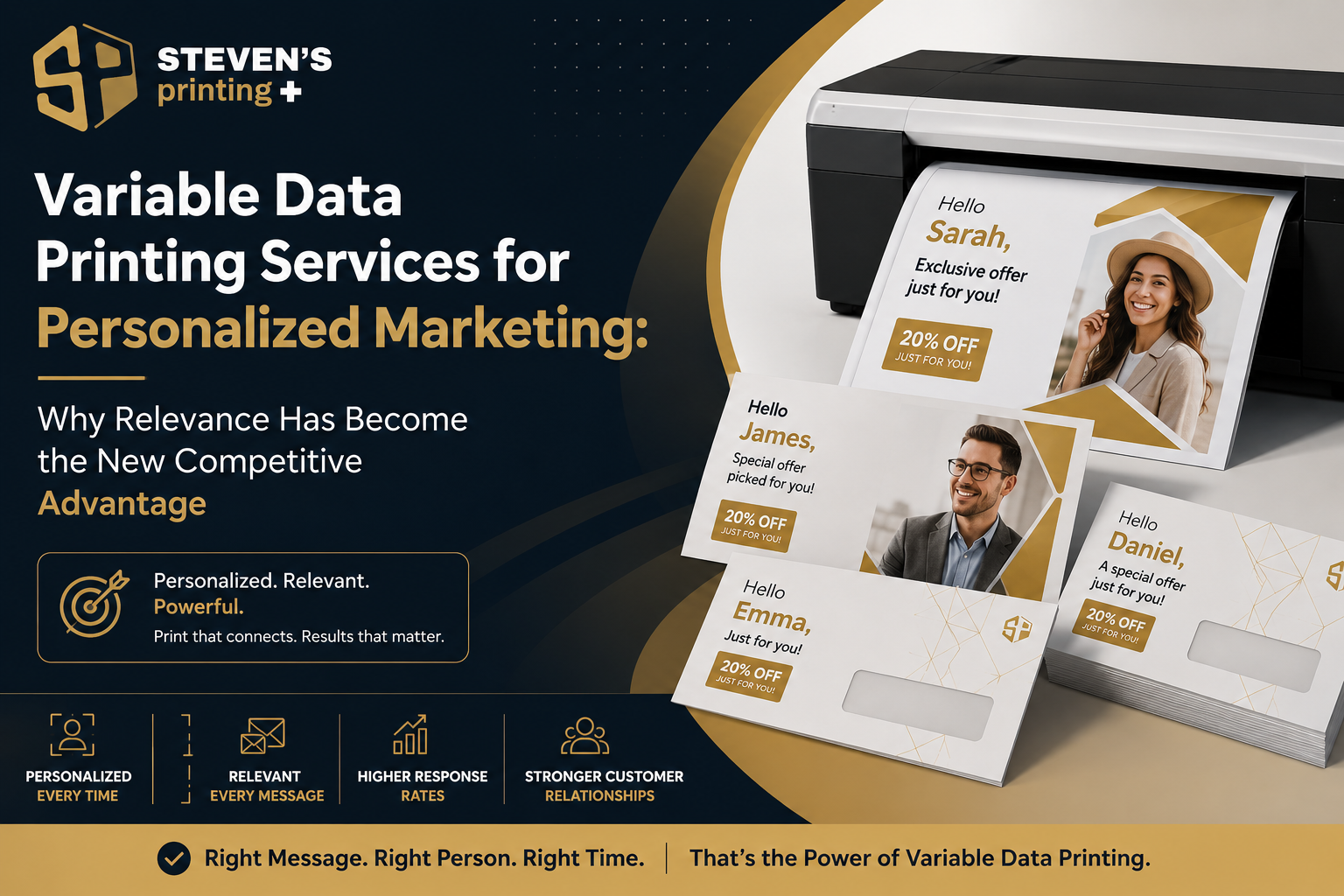
Variable Data Printing allows organizations to customize multiple elements within a printed piece while maintaining the efficiency of large-scale production. Text, images, offers, graphics, maps, QR codes, and even entire sections of content can change from one recipient to another without interrupting the printing process.
This capability creates opportunities for a far more sophisticated level of communication.
A retail company can showcase different products based on previous purchasing behavior.
A healthcare provider can deliver information tailored to specific patient groups.
A university can send prospective students content aligned with their academic interests.
A nonprofit organization can highlight stories and initiatives that resonate with different donor segments.
A real estate company can feature neighborhood-specific information based on a recipient’s location.
In each case, the goal is not simply personalization for the sake of personalization. The goal is relevance.
The message becomes more meaningful because it aligns with the recipient’s circumstances rather than treating every audience member exactly the same.
Why Personalized Print Is Standing Out in a Digital World
One of the more surprising developments in modern marketing is the renewed effectiveness of print.
For years, many experts predicted that digital communication would eventually replace printed marketing materials altogether. Instead, something different happened.
As digital channels became increasingly crowded, physical communication began to attract attention again.
Consumers receive countless emails every week. Social media feeds move at incredible speed. Digital advertisements compete for visibility across dozens of platforms.
Printed communication operates differently.
It is tangible.
It occupies physical space.
It can be picked up, reviewed, shared, and revisited.
Unlike a promotional email that disappears beneath dozens of new messages, a personalized mail piece may remain on a desk or kitchen counter for days. This creates additional opportunities for engagement and recall.
What makes Variable Data Printing particularly valuable is its ability to combine the impact of physical marketing with the relevance consumers have come to expect from digital experiences. Businesses no longer have to choose between personalization and print. They can achieve both simultaneously. Personalized print campaigns can incorporate customized offers, images, QR codes, geographic information, and customer-specific messaging within a single production run.
As a result, printed communication often feels more intentional, more memorable, and more difficult to ignore.
The Future of Marketing Is More Human
Technology continues to evolve at an extraordinary pace. Artificial intelligence, automation, predictive analytics, and advanced customer data platforms are transforming how organizations communicate with their audiences.
Yet despite these technological advances, the fundamental principle behind effective marketing remains unchanged.
People want to feel understood.
The future of marketing will not belong to the businesses that send the most messages. It will belong to the businesses that deliver the most relevant ones.
Variable Data Printing is part of this broader shift. It allows organizations to move beyond mass communication and toward more meaningful engagement. Instead of speaking to everyone the same way, businesses can communicate with greater precision, empathy, and relevance.
That approach benefits everyone involved. Consumers receive information that is more useful to them. Businesses improve engagement and campaign performance. Communication becomes less intrusive and more valuable.
In a world where attention is increasingly difficult to earn, relevance has become the new competitive advantage.
The organizations that understand this reality—and invest in communication that feels personal, thoughtful, and meaningful—will be far better positioned to build trust, strengthen relationships, and stand out in an increasingly crowded marketplace.