
That description feels increasingly outdated.
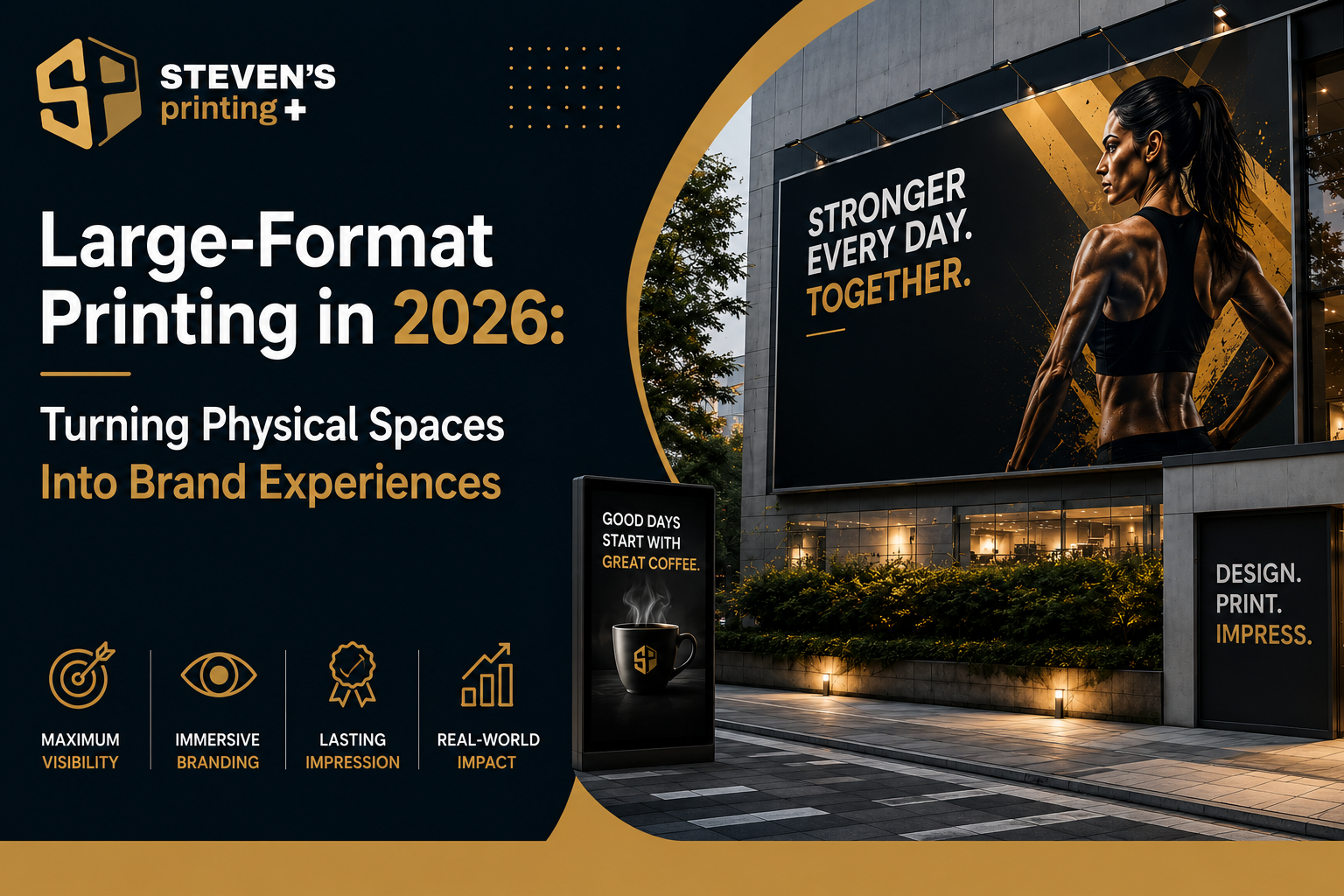
In 2026, some of the most interesting uses of large-format printing have less to do with simply making a message bigger and more to do with changing the way people experience a physical space. Retailers are turning stores into destinations. Businesses are transforming ordinary walls into branded environments. Events are using printed graphics to create immersive settings rather than simply displaying logos. Even spaces that once served a purely functional purpose are becoming opportunities for storytelling.
The shift is happening for a simple reason: people can get information almost anywhere. They can compare prices from their phones, watch product demonstrations online, read reviews before entering a store, and order something without ever speaking to another person.
What the digital world cannot easily reproduce is the feeling of actually being somewhere.
That is where physical design becomes important again.
Large-format printing sits directly at the intersection of branding, architecture, retail, events, and customer experience. It gives businesses a way to turn physical environments into something more memorable—and increasingly, more connected to the digital world.
The Physical World Is Becoming a Brand’s New Canvas
The idea of a store as simply a place where transactions happen is changing.
Retailers are experimenting with environments designed to encourage discovery, interaction, and emotional connection. Physical stores are increasingly being treated as destinations rather than simply points of sale.
That creates an interesting opportunity for print.
A wall does not have to be just a wall.
A window does not have to be just glass.
A floor does not have to be simply something people walk across.
A vehicle does not have to be just transportation.
Each can become part of the brand experience.
A large printed mural can establish the personality of a restaurant before a customer sits down. A dramatic window graphic can turn an ordinary storefront into something people photograph and share. A branded environment at a trade show can make a small company feel established before a salesperson says a word.
This is a different way of thinking about large-format printing. The objective is no longer simply to display information. It is to shape the environment in which people encounter a brand.
That distinction matters.
From Advertising to Experience
Modern consumers are surrounded by advertising, but they are not necessarily looking for more advertisements.
They are looking for experiences.
That is one reason experiential marketing continues to grow. Retail leaders have increasingly focused on physical environments designed around immersive and interactive experiences rather than traditional visual merchandising alone.
Large-format graphics can play a surprisingly important role in that transition.
Imagine walking into an event where every wall, entrance, stage backdrop, and directional sign feels disconnected. The event may function perfectly, but it probably will not feel particularly memorable.
Now imagine entering a space where the graphics, colors, photography, typography, and messaging all work together. The environment immediately feels intentional. You know where you are, what the event represents, and what kind of experience you are about to have.
That is the difference between decoration and design.
Large-format printing becomes powerful when it is treated as part of the experience rather than something added at the end.
For conferences, sporting events, retail launches, exhibitions, restaurants, and corporate environments, printed graphics can help create a sense of place. They can guide people through an environment, establish visual continuity, and reinforce a brand without requiring customers to consciously process an advertisement.
The Rise of Shareable Physical Spaces
There is another reason large-format design is becoming more interesting: the physical and digital worlds are no longer separate.
A person might walk into a beautifully designed space, take a photograph of a wall installation, post it on Instagram or TikTok, and unintentionally turn a physical graphic into digital content.
Suddenly, one printed wall is doing two jobs.
It is communicating with the people physically present while also becoming part of the online conversation.
This is particularly important for businesses that depend on social visibility. A memorable backdrop at an event, a creative storefront installation, or an oversized branded display can encourage people to photograph themselves within the environment.
The result is a form of marketing that begins in the physical world and travels into the digital one.
That crossover is becoming increasingly important as brands look for ways to create content that does not feel manufactured for social media. A space that naturally makes people want to take a picture can generate something far more valuable than another conventional advertisement: voluntary participation.
Personalization Is Changing Large-Format Printing, Too
Large-format printing is also becoming more flexible.
Digital printing technology has made it easier to produce customized graphics without relying exclusively on enormous quantities of identical materials. That opens the door to location-specific campaigns, customized event environments, store-by-store graphics, and creative variations designed for particular audiences. Current wide-format printing coverage also points to customization and personalization as important developments in the industry.
This changes the economics and creative possibilities of physical marketing.
A national campaign does not necessarily have to look identical everywhere.
A retailer can adapt graphics to different neighborhoods. An event can incorporate local references. A multi-location business can create variations that reflect individual markets. A seasonal campaign can be updated without completely rebuilding an entire visual system.
In other words, large-format printing is becoming more agile.
The old image of a printer producing one giant banner and sending it out into the world no longer captures what the technology can do.
Sustainability Is Becoming Part of the Conversation
There is also a growing expectation that visual impact should not come at the expense of environmental responsibility.
In 2026, sustainability and circularity are increasingly being discussed alongside visual merchandising and physical brand experiences. The conversation is shifting from simply asking whether something looks impressive to asking how materials are sourced, used, reused, and eventually disposed of.
That matters for large-format printing because the industry works with a wide range of substrates, inks, and display materials.
For businesses, this creates an opportunity to think differently about temporary campaigns and permanent installations. Can a display be reused? Can materials be selected with a longer lifecycle? Can graphics be updated without replacing an entire structure?
Sustainable printing is not simply an environmental conversation anymore. It is becoming part of how brands communicate their values.
For companies that want their physical presence to reflect what they stand for, material choices can become part of the story.
Bigger Does Not Necessarily Mean Louder
The future of large-format printing is not simply about producing larger graphics.
It is about producing smarter ones.
A giant advertisement with too much text can still be ignored. A massive sign with no creative thought behind it can become visual clutter. Size alone does not create impact.
Context does.
A well-designed graphic placed in exactly the right environment can communicate more effectively than something twice its size. A carefully considered storefront can make a business feel established. A thoughtfully designed trade show environment can invite conversation. A creative wall installation can turn an ordinary room into something people remember.
That is why the most interesting large-format projects increasingly involve designers, marketers, and businesses thinking about the entire customer journey—not simply the printed surface.
Where will someone first see the graphic?
What will they notice?
Where will they walk next?
What should they feel?
Could the space encourage them to take a photograph?
Can the physical experience connect them to a digital one?
Those questions are turning large-format printing from a production service into a creative component of modern brand strategy.
The Next Chapter of Large-Format Printing
The irony of the digital age is that the more time people spend online, the more valuable memorable physical experiences can become.
Digital content can be changed in seconds. Physical spaces cannot. That limitation is also their strength.
A well-designed physical environment feels real because it is real. People can walk through it, touch it, photograph it, and share it with others. It creates memories that exist outside a screen.
That is why large-format printing is evolving rather than disappearing.
The future is not necessarily about printing the biggest banner or covering the largest wall. It is about understanding how physical graphics can become part of a larger experience—one that connects branding, design, technology, culture, and human behavior.
The brands that understand this shift will stop thinking of large-format printing as simply a way to make something visible.
They will start thinking of it as a way to make something felt.
And in a marketplace where consumers can scroll past almost anything, creating an experience they actually remember may be the bigger impact of all.